Sirius Outpost
Section 1: The Question of Orientation
This began as a fun project and a persistent question, a curiosity about why, amidst all the motion and sound and decisive energy of our world, it so often feels that we are moving without arriving, acting without progressing, as if the very speed of our passage has blurred the horizon we once steered by.
I am, by nature and by training, a systems architect, which means I see the world in relationships, in forces and counterforces, in the subtle but stubborn gaps between intention and outcome, and it occurred to me that we are all, in a sense, pilots navigating an ever shifting sky, full of energy and opportunity but dangerously lacking a stable horizon.
We live in an age of immense airspeed, of markets accelerating, technologies compounding, narratives clashing, a great and constant forward thrust that fills our instruments with data and our minds with the sensation of progress, yet so much of this motion occurs within a moving air mass, within winds of demographic change, of institutional inertia, of liquidity and cultural current, which means we can be flying with tremendous effort and conviction only to find ourselves, hours later, startlingly off course, having confused the feeling of movement with the reality of navigation.
What we have lost is the ancient, vital discipline of orientation, the skill of separating the aircraft’s energy from the wind’s will, of reading not just the dials in front of us but the relationship between our heading and a fixed point far away, a star to steer by.
Section 2: The Search for a Fixed Point
This loss of reference is why a strange pattern emerges among those who work close to long term decisions. The people with the most resources, the longest horizons, and the least need to justify themselves often pay attention to things that sound unserious when mentioned aloud. Cycles, seasons, alignments. Not as superstition, and not as prediction, but as reference. This is usually flattened into the dismissive phrase “billionaires follow astrology,” which misses the point almost entirely. What they are following is time that does not negotiate.
Our modern systems are built on calendars that drift. Fiscal years, election cycles, quarterly reports, these are useful abstractions, but they are self referential. They respond to human behavior, and they can be stretched, compressed, or gamed. When everything references everything else, orientation degrades quietly. The oldest and wisest solution to this was disarmingly simple: anchor time to something that does not respond to humans at all.
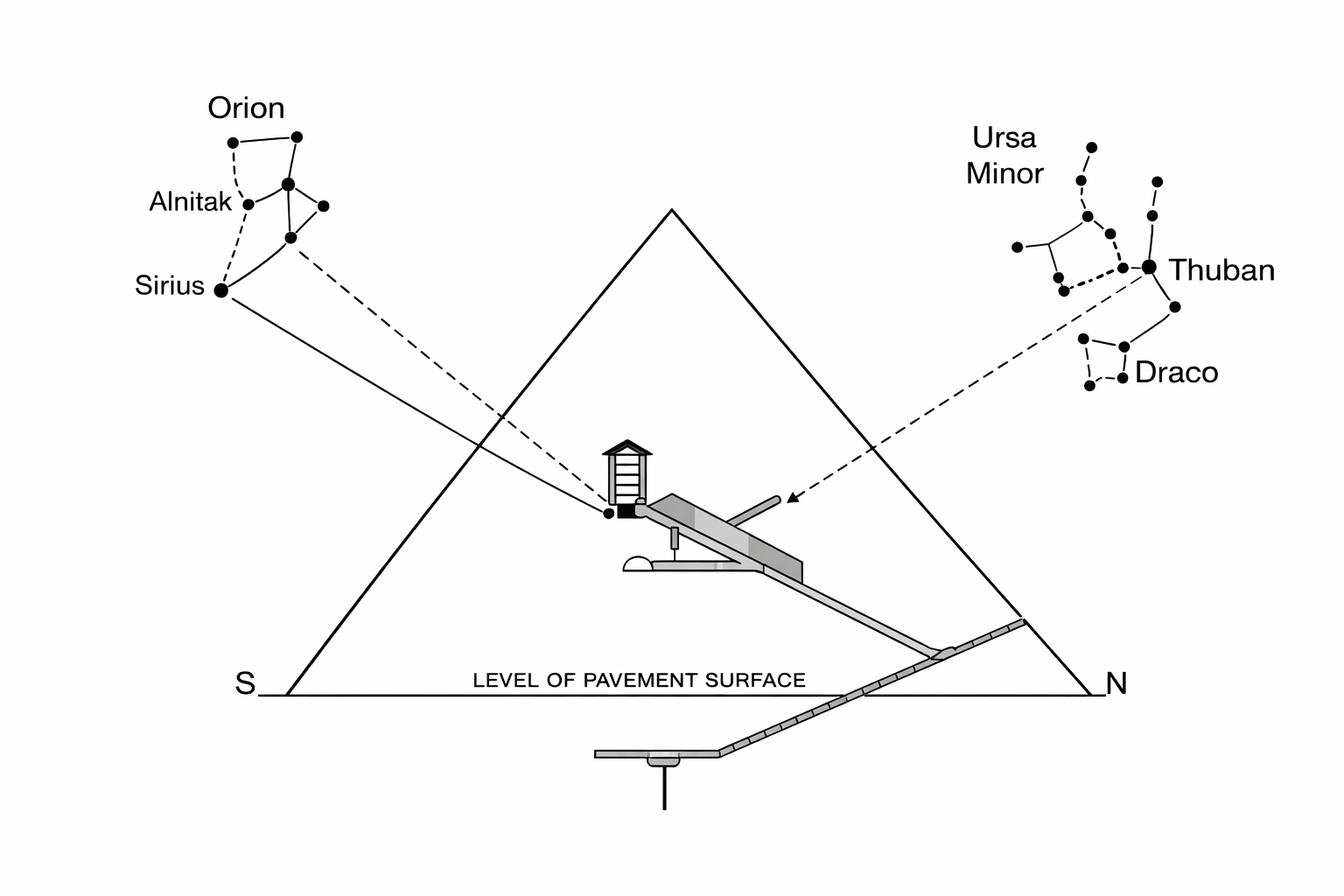
To understand this instinct, we must look past the modern assumption that ancient civilizations were attempting to command the heavens. Their pursuit was both simpler and more profound. Consider the Egyptians. They were not trying to “align the planet” in a global, centralized sense. They were fixing human order to a non human reference in a way that could survive centuries of drift. The pyramids are their testament: their cardinal alignment is tighter than most modern constructions, achieved without magnetic compasses. Orientation was not decorative. It was foundational.
Sirius mattered operationally. Its heliacal rising marked the new year. It synchronized the Nile’s flood, and thereby agriculture, administration, ritual, and taxation. It synchronized the state. Here is the key distinction, elegant in its clarity: they were not using the pyramid to control the sky. They were using the sky to stabilize the ground. The pyramid functioned as a fixed frame, a geometric benchmark making celestial drift visible across generations. It did not predict change. It revealed it.
They did not “believe” in Sirius in a modern, symbolic sense. They trusted it as a clock. They trusted geometry as a constraint. They trusted orientation over interpretation. That trust, in an external, stable, and indifferent reference, is what our modern, endogenous systems have largely lost.
Section 3: The Philosophy of Sirius Outpost
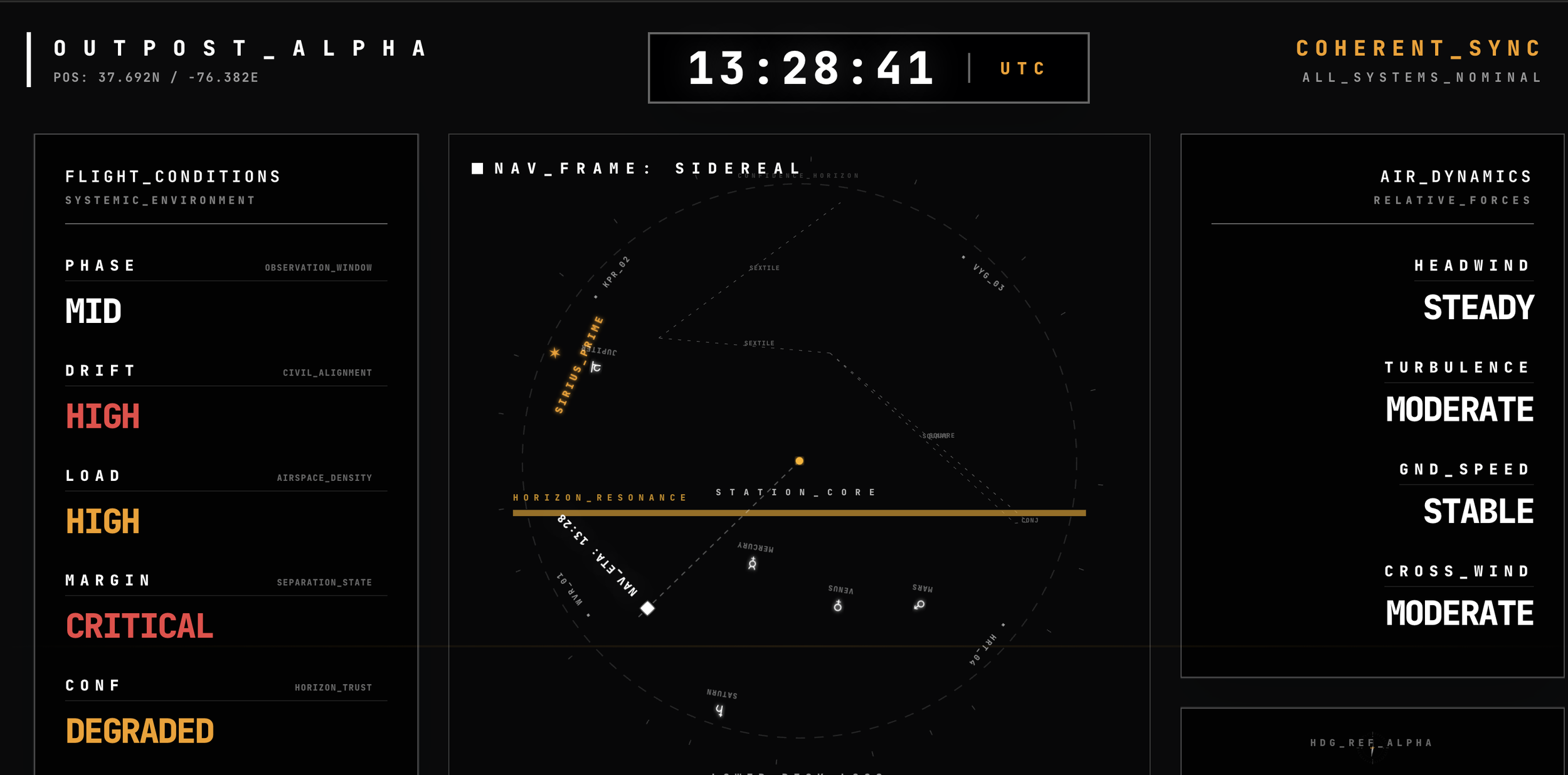
And so Sirius Outpost was born from this convergence. It is not a predictive model or a manifesto. It is an instrument of orientation. A carefully calibrated panel built to hold one steady line against the noise. To make visible, in calm and deliberate light, the difference between where we are pointed and where we are actually going. Between the force of our will and the drift of the world. I am not resurrecting ancient mysticism. I am rediscovering an old engineering instinct: when everything moves, fix your reference outside the system.
Section 4: The Anatomy of Flight
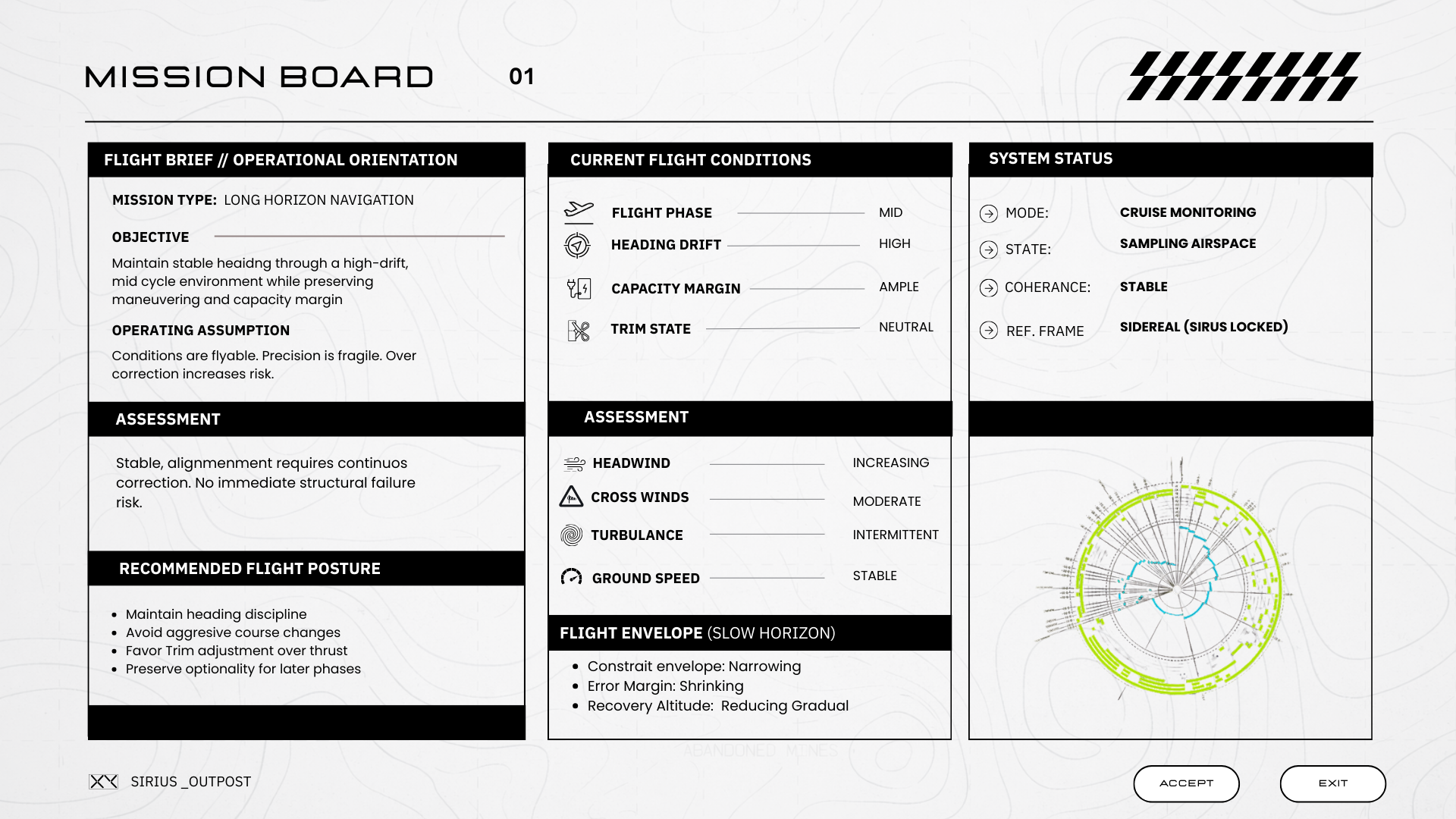
The instrument begins, as all wise flight begins, by establishing posture. It asks you to acknowledge, before any action, the phase of the journey, the quality of the air, the margins you hold. A pilot does not judge a storm by the turbulence alone, but by the strength of the aircraft and the clarity of the horizon.
We then turn to the state of the vessel itself, your venture, your strategy, your position. We listen for the subtle signals of alignment or strain: the quiet hum of systems in trim, the gentle drift of the nose from the plotted line, the remaining capacity not just for thrust but for correction. A journey’s success is found not in a single brilliant maneuver, but in the sustained ability to hold course, to adjust without jerking the wheel, to conserve strength for the winds we cannot yet see.
And around us, always, is the air, the medium through which we move, which we can neither command nor ignore.
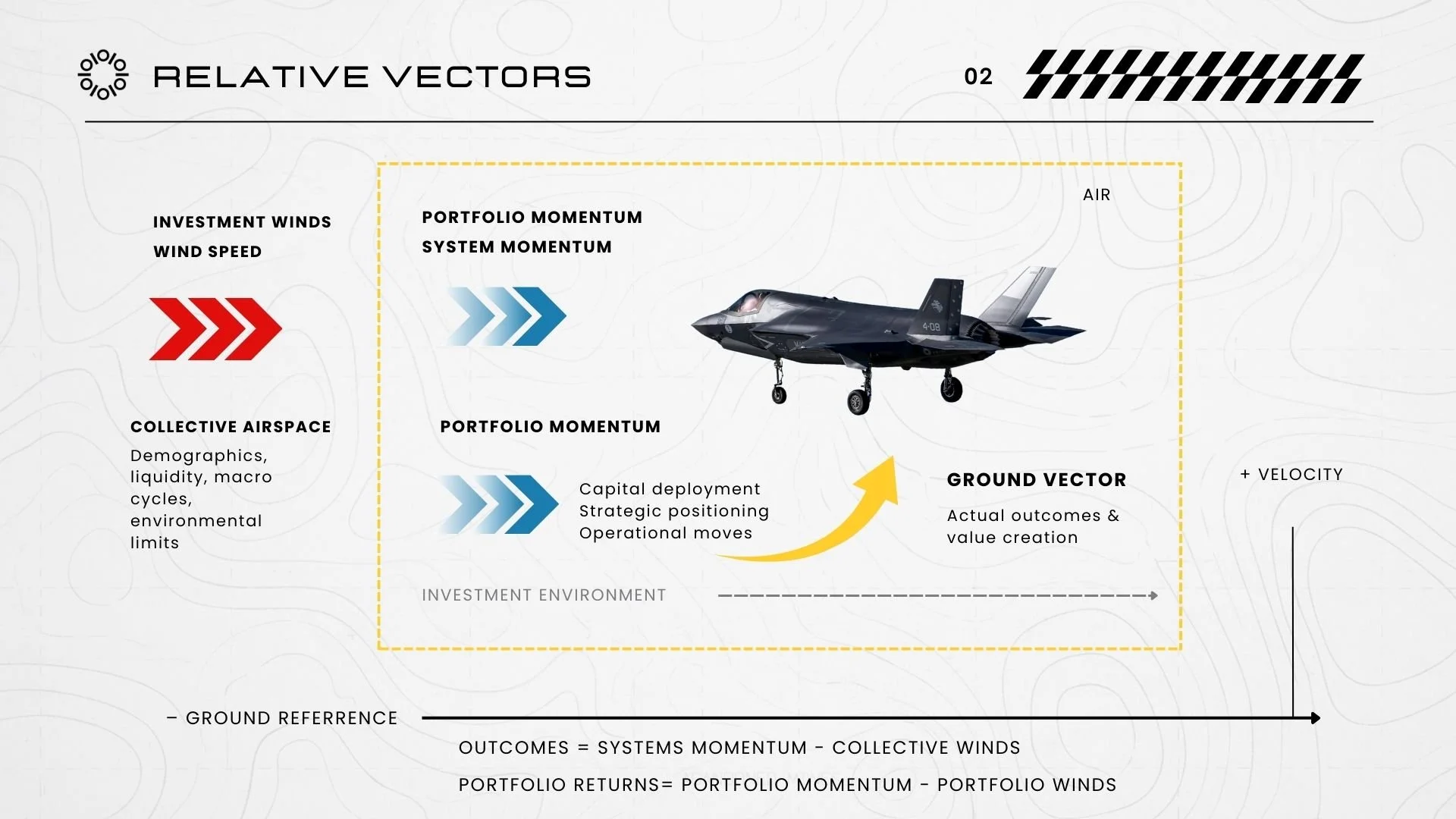
Its currents lift us or push us sideways; its turbulence shakes the cockpit but rarely changes the destination. This is where most analytical dashboards fail. They shout of the shaking and forget the current. They make the wind a problem to be solved, rather than a condition to be read, a force to be respected and folded into the geometry of our passage.
From this quiet, disciplined reading emerges the only truth that matters: the ground track. The actual path of our lives and ventures over the earth. It is the final, sobering sum of airspeed plus wind, of effort plus reality. It is a line that speaks not of our hopes, but of our position. And it is to this line we must gently, constantly, align our will.
Section 5: The Sidereal Anchor
This is why Sirius Outpost’s final anchor is not to the shifting maps of men, but to the fixed stars. To a sidereal time that flows, unmoved by our haste or our worry.
Because when you are tired and lost in the clouds, when every instinct screams to dive or to climb, you must have one thing that does not move. One point of light to trust beyond the noise. And you must learn, through discipline, to believe it more than you believe your own fear.
That is the heart of this project. To build that trust. To craft that steady light, not as a theory but as a lived practice. In aviation, pilots do not believe in the horizon. They trust it.
It is a small thing, this outpost by a distant star, but it is built on the old and quiet belief that the way through chaos is not more control but better reference, not louder commands but a calmer instrument, and that sometimes the most powerful act is not to move the wheel but to steady your eyes, to take a long breath, and to remember how to fly.
➡️ Check out Sirius Outpost Here
P.S.
Some of the spark for this came, unsurprisingly, from fiction. From stories that weren’t really about the future so much as about scale, perception, and what happens when systems grow larger than individual intent. I’ve been rereading Asimov’s Foundation series and revisiting Electric Dreams, and what stayed with me wasn’t prediction or spectacle, but the shared question underneath them both: what do you do when structure matters more than belief, and when the hardest thing is not acting, but staying oriented. This project isn’t an attempt to build a Prime Radiant or to take science fiction literally. It’s closer to a quiet nod to the discipline those stories point toward, the habit of zooming out far enough to see the currents, while staying humble about what can and can’t be known.
I’m playing at the edge where curiosity lives… serious about asking real questions, but light enough not to let the questions become rigid dogma. It’s that space where I’m open to possibilities, but grounded enough to keep perspective. In other words, it’s the perfect place to explore new ways of seeing. Serious and not too serious because that balance is where creative insight often emerges. 😜
xx, C