Conditions for building
I keep returning to the same quiet question, as a steady companion that walks beside me through the day. I find myself asking what I want to do with my life now, now that the old urgency to perform has finally fallen away. I left the nine to five, I loosened my grip on proving, on accumulation, on doing more for the sake of momentum alone. What I did not expect was that in the letting go, something much quieter and more demanding would come forward. Now I wake up with a low thrum of excitement from sensing ideas waiting to be met, and from people arriving with questions that feel less like requests and more like invitations, open doors.
My mind has always traveled this way, weaving threads across history and bodies, myth and cities, ecology and psychology. For a long time I thought this movement meant I lacked focus, that I needed to specialize, to narrow myself to a single lane in order to be of use. I see it differently now. This synthesis is not a distraction but is my function, a particular way of knowing. But I have learned it only works when it is deeply rooted, when the weaving has a home to return to.
Everything that is truly meaningful seems to begin at home as a condition of being. A peaceful home is known by the way time softens within its walls, becoming spacious and fluid, and by how the nervous system gets to rest and breathe deeper. There is a warmth without intensity, an order without any rigidity. You do not have to split yourself in two to belong. The nervous system, at last, knows where it is, not just in space, but in the sequence of things.
I believe this is how civilizations begin, too.
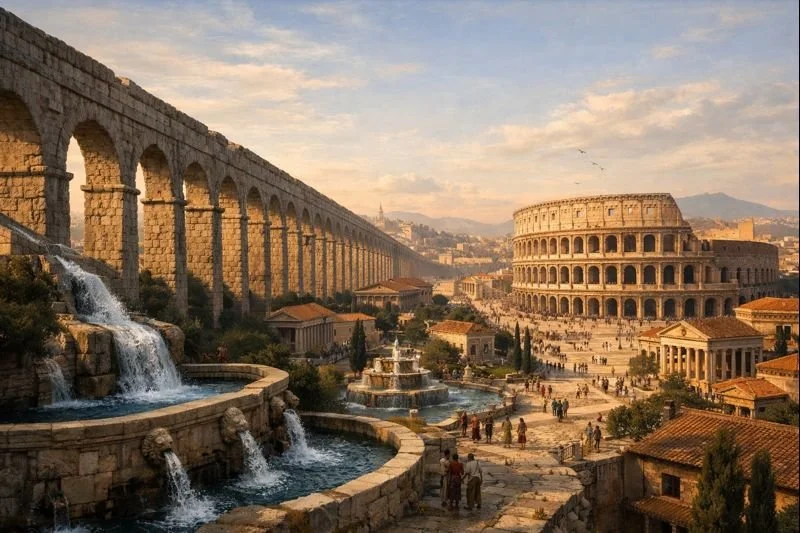
When I think of Rome, of its aqueducts carrying clear water across impossible distances, of engineers who could flood the Colosseum without a single tractor or modern pump, I do not see lost genius. I see a profound integration. These were not specialists working in isolation, they were polymaths, builders who understood geometry and hydraulics, politics and ritual, and the human body itself as parts of a single, coherent system. Their innovation did not come from optimization alone. It came from an intelligence that was allowed to move freely between domains, long enough and with enough support that it could become structure. Their architecture showed care, philosophy translated into form.
We did not lose that capacity for integrated intelligence, somehow only fragmented it.
As our societies scaled, mind slowly separated from making. Soul separated from structure. Thinking was rewarded without the requirement of embodiment. Building was accelerated without the space for reflection. Genius became an individual trait rather than a civic function. The intelligence is still there, everywhere, but the conditions that allowed it to compound, to build upon itself into something lasting, have been quietly eroded.
I remember once going on a walk with a friend who happened to be an architect. We were just walking, not toward anything important, just alongside a sidewalk most people would not notice. And as we walked, he began to talk, in a way that felt like thinking out loud.
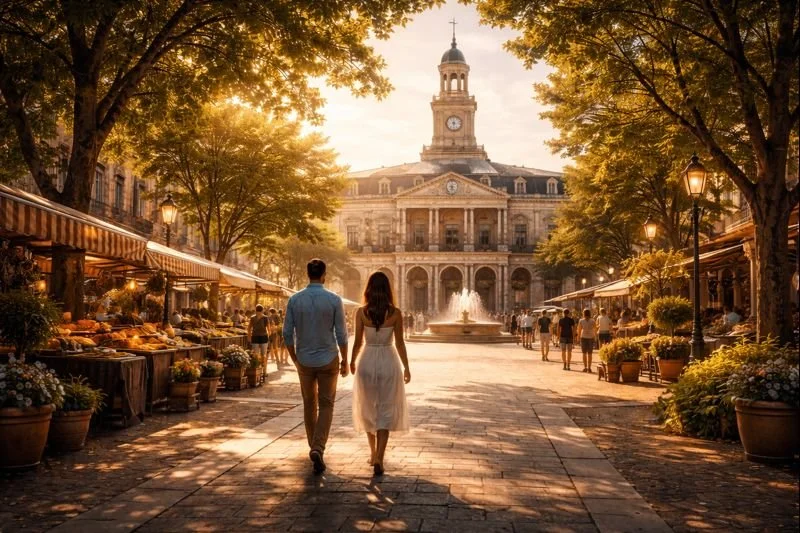
He pointed to the sidewalk and said how communities need this, not just as infrastructure, but as an ecology. How a sidewalk gives permission to slow down, to walk beside someone, to be seen without having to buy anything. He talked about how the placement of a building could decide whether a morning farmers market felt alive or exhausted, how the angle of the sun mattered, how a little shade could make people linger instead of rush. The same plaza at night, music filling the space, is where community gathered making the space more alive.
He spoke about libraries, how a dome changes how we think, how a ceiling that opens upward invites free thought in a way flat lines never do. He talked about details, small ones, almost invisible ones, and how they quietly shape behavior, mood, and possibility. He said these little decisions make a massive difference, and I believed him without needing proof.
What I notice now is not just what he said, but how my body responded. I did not interrupt him. I did not try to add anything, I just walked beside him and listened. Something in me recognized that way of seeing. The care, the attention to first conditions. The belief that how we arrange space is how we teach people what life feels like.
I realize I was not moved by architecture itself, but by the orientation behind it. The desire to build in a way that considers the nervous system, the rhythm of a day, the way people arrive and leave. I think I recognized my own language in his, even though it wore a different uniform. Where he spoke of sunlight and sidewalks, I have always felt atmosphere and lineage. But it was the same sensitivity.
That walk stayed with me because it reminded me that worlds are not built through force or spectacle. They are built through placement, listening, through decisions made with care for bodies that will pass through long after the builder is gone. And maybe that is why it felt intimate without being romantic. It was a shared way of seeing, gently unfolding, step by step, along a sidewalk most people never notice.
Our modern cities still teach us this, if we listen quietly. Cities send messages through what they admire, what they reward, what you overhear drifting through open windows at dusk. New York whispers of wealth, Silicon Valley hums with the raw currency of power, Cambridge asks you, above all, to be smarter. These messages tune our ambitions over years, bending our growth like trees in a prevailing wind. Cities are not just collections of buildings and roads. They are vast, collective nervous systems.
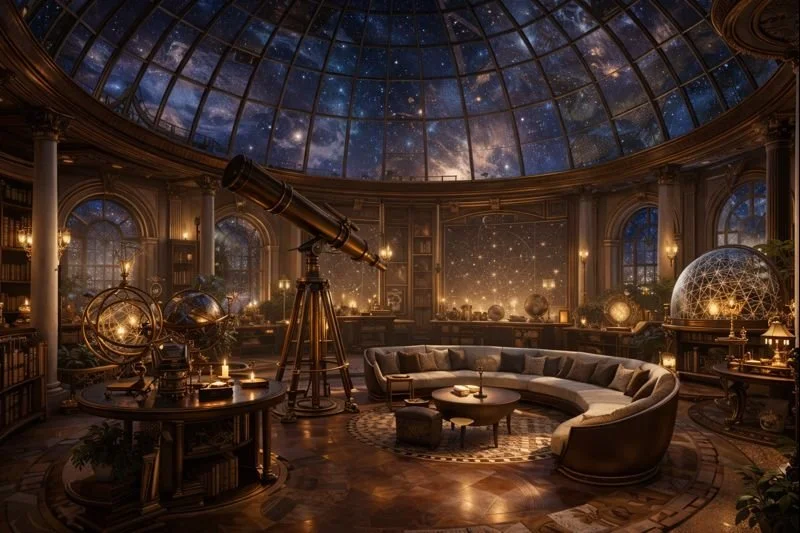
Polymath’s Study
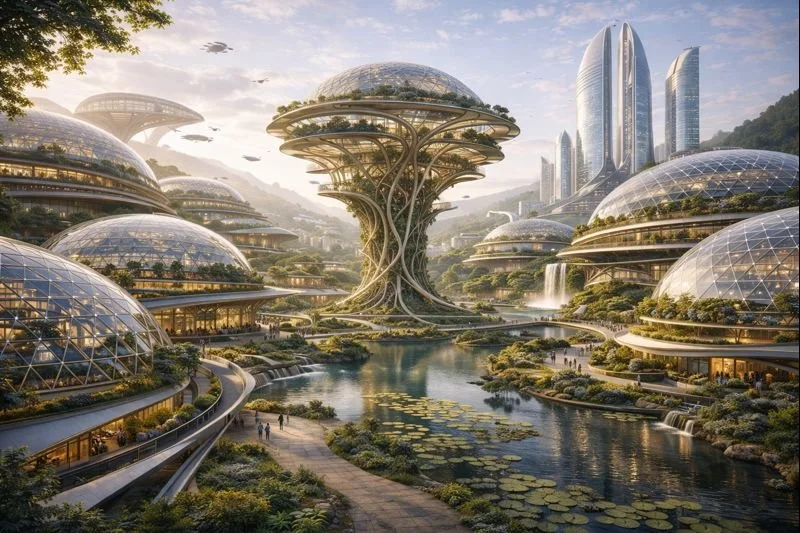
What I find myself imagining now is not a city that sharpens its people through pressure, but one that deepens them through nourishment. A place where the ambient message is not try harder, but go deeper. Where ambition is not extracted through comparison, but drawn out by resonance. Where local ecology is not a decoration, but a collaborator. Where people become creators not because they are relentlessly driven, but because they are regulated enough to truly imagine.
This understanding is why my work begins with one nervous system at a time.
I am calibrating people first, not scaling ideas. In the one on one spaces, I work with the body and its history, with the story and the lived patterns that keep repeating just beneath the surface of conscious intention. When a nervous system settles, when it feels safe enough to remember itself, the person’s gifts amplify naturally. Clarity emerges without being forced. They remember what they are here to build because then true collaboration follows, and this is a state of regulation that is quietly contagious. This is slow work by its very design. It is the way conditions are restored before any new structure is raised.
The vision that returns to me has a clear shape now. A grand library, a temporal space where thinking is allowed to lengthen. An embodiment space, that fosters wellness culture as essential civic infrastructure for regulation and recovery. A living network where people learn in public, build in collaboration, and leave clear trails for those who are walking a few steps behind. This is not a movement or a manifesto. It is the architecture for a living ecology.
At the heart of this lies a simple trinity that is not theoretical. I watch it operate in daily life constantly. When you decide to change something, the mind must first see what is actually happening. It needs to recognize the pattern, to understand the system, to imagine a true alternative. Without this clear sight, there is no orientation.
Then the soul must feel the desire for the change. It must care, deeply. It must attach meaning and longing to the vision so that the heart commits to the path. Without this feeling, understanding remains inert, a map you never use.
Finally, the body must act. It must take the concrete, material steps, day by day, to build what the mind saw and the soul felt. Without this action, vision fades back into pleasant abstraction.
If you only think, you become someone who understands everything and transforms nothing. If you only feel, you create great emotional intensity without direction or durability.
If you only act, you build structures that inevitably replicate the very patterns they were meant to change.
Mind, soul, and body are mutually dependent. Remove one, and the others slowly fail. So many modern spiritual projects forget this. They overdevelop one dimension and neglect the rest. Philosophy without embodiment, community without structure, technology without consciousness. The result is always the same, a new fragmentation disguised as progress.
This is why my work must operate across all three at once. Narrative, experience, and manifestation. Purpose, identity, and form. It is thought that is grounded. Feeling that is oriented and action that is alive.
I see now how much of this wisdom flows through the feminine, not as an ideology, but as a necessary function. Women shape atmosphere. They hold the first city, the home, where life learns whether it is safe to unfold. Sacredness here is not about purity but about pacing. It is what is protected from being used up. It is in the unrushed meal, in speech that does not cheapen intimacy, in silence that contains rather than withdraws. It is in the refusal of false urgency. It is in the tending of the long arc.

Builders, true builders, do not need to be managed. They need to know that what they create will be properly received, inhabited, and allowed to live on beyond the initial performance. Inspiration is not instruction. It is presence without need. It is beauty without a demand. It is a stillness that signals continuity. When that field exists, effort becomes devotion rather than strain.
I know this is possible because I feel it happening already. The right people arrive. Our conversations deepen of their own accord. Projects emerge without being forced. Collaboration forms simply because the conditions are right.
I believe we create our worlds first through imagination, but imagination only becomes real when it is given a place, a rhythm, and genuine care. Great cities have always attracted ambitious people. But perhaps the next great places will attract integrated people, and from that foundation of integration, ambition itself will take a different, more durable shape.
Not harder but deeper and more true.
My work now feels simple, even if it is not small. To tend the conditions, restore alignment and let the feeling of home scale gracefully into culture, and let culture mature into structure, without ever losing the original warmth that made it worth building in the first place. I am longer willing to fragment myself to fit a smaller world. I am building at the scale of my own integrity, and inviting others to do the same.
Thank you, sincerely, to each new person who has arrived here and chosen to subscribe. Your presence is a form of contribution, and it is deeply felt.
What I write is rarely pre-planned. It arrives first thing in the morning, a form of free thought where I listen for what my higher self wishes to articulate, to learn, to remember. This practice is my own calibration. I share it here, openly, because this work is not meant to be gatekept. It is an open source of inquiry, a shared library for those who sense the same call to rebuild from a foundation of integration.
My commitment is to no longer fracture my self across ten different platforms, burning out in the process. I am building a single, coherent body of work, not chasing scattered attention. My goal is to help you do the same, to build in your own unique, calibrated style, and to leave a clear trail for those walking the path behind you. This is how we learn in public, together.
If this entry resonated with you, if it felt like a piece of a world you also wish to inhabit, please consider sharing it with one person who might find it valuable. Word of mouth remains the oldest and truest way to build a world with people who resonate with one another.
With gratitude,
Celinne