Theodore Roosevelt and the Waters of Empire
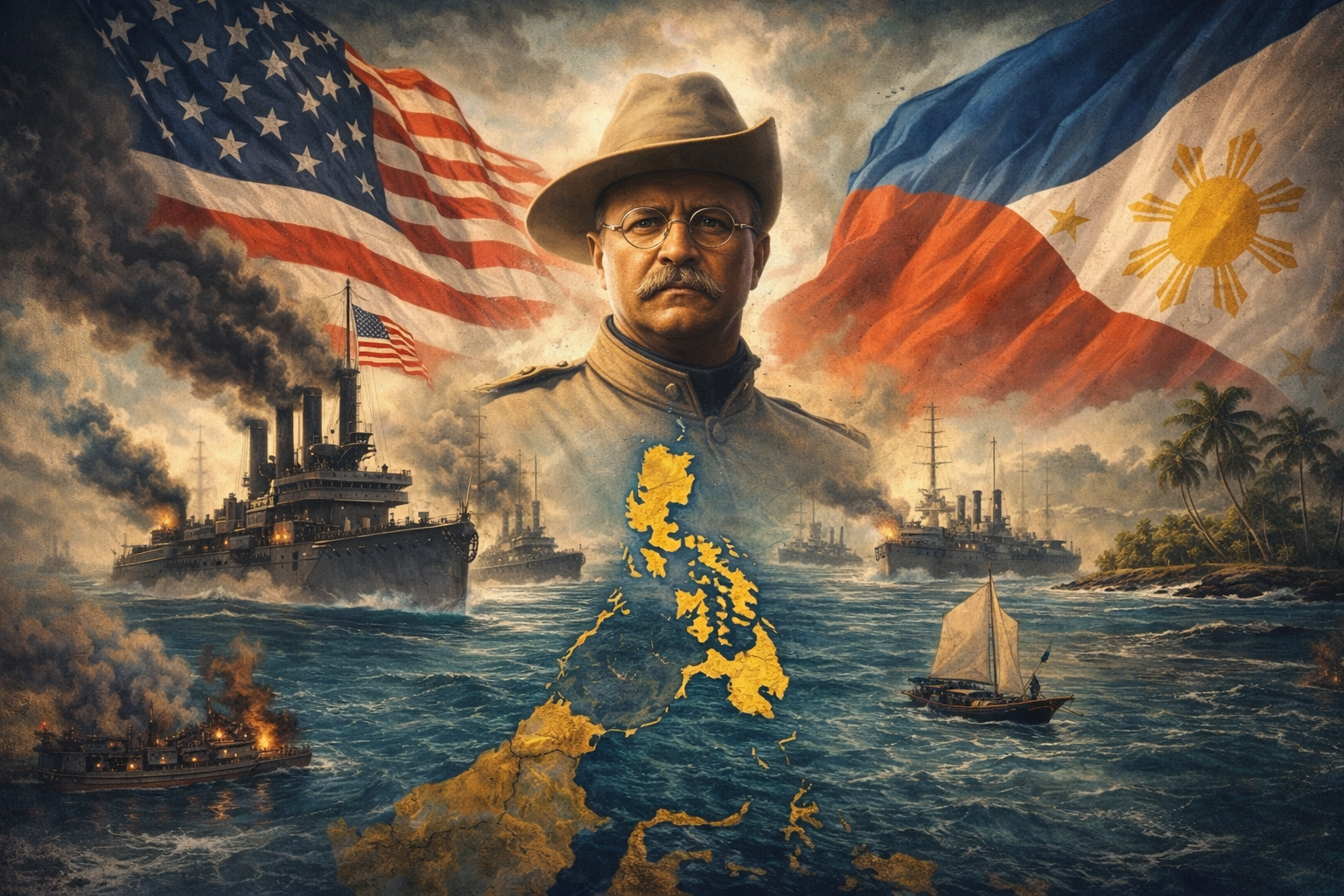
I keep coming back to the same realization, and each time it arrives with more force. These are water wars. Not only the obvious wars fought by navies, not only the wars of island chains and ports and harbors, but the deeper struggle underneath empire itself. The fight is over movement. Over access. Over the routes that make trade possible, the passages that make supply sustainable, the chokepoints that make pressure legible, the coastlines that turn geography into leverage. Oil matters, land matters, armies matter, but beneath all of it is circulation. Who moves freely. Who is blocked. Who must ask permission to pass. Who controls the crossing and can therefore shape the future.[1]
This is the thread I have been following across so many different terrains, through Petra, through dams, through old imperial maps, through military memory, through the inherited stories that do not leave a family even when the war itself is generations past. As a Filipino, this history does not feel abstract to me. I grew up surrounded by the afterlife of these waters. I heard World War II in the voices of my grandparents. I grew up around military people, around the language of deployment and strategy, around the understanding that seas are never only scenery. Water was always alive with consequence. It carried occupation, retreat, supply, invasion, return. It carried empire.
That is why Theodore Roosevelt matters so much in this story. He stands at a hinge point, at the moment when sea power was no longer simply a military concern but became a philosophy of national destiny. He did not invent the sea, and he did not invent empire, but he helped give the United States a vocabulary for using maritime power as political will. He helped translate a theory into posture, and posture into action.[2]
To see that clearly, it helps to begin not with Roosevelt himself, but with Alfred Thayer Mahan. Mahan’s importance is not only that he wrote about navies. Many men wrote about navies. His importance is that he wrote about the sea as a total system. In The Influence of Sea Power upon History, Mahan says directly that his purpose is to place maritime interests in the foreground and to show their effect on the course of history and the prosperity of nations. That is already larger than naval warfare. He is telling the reader that the sea is not a backdrop to history. It is one of history’s engines.
Mahan’s framework is blunt in its clarity. Maritime power rests on a chain. Production, shipping, and colonies are linked. Commerce requires movement. Movement requires protection. Protection requires ships, ports, and bases. Ships that move back and forth across the world need secure harbors to return to, and traders moving into distant waters need stations where they can take shelter, gather goods, refit, and survive long routes. Over time, those stations grow into colonies, and those colonies become the infrastructure that supports larger power. This is one of the most revealing parts of Mahan’s theory. Colonies are not only trophies. They are logistical organs.
He goes even further. Governments that want sea power, he argues, must maintain suitable naval stations in distant parts of the world, because warships must follow where commerce goes. A scattered empire can be held together if it has bases abroad, secure lines of communication, and naval superiority sufficient to keep those lines open. In another passage, Mahan describes sea control as the power that closes the highways by which commerce moves to and fro from the enemy’s shores, which reveals with unusual precision what command of the sea really means: command over circulation itself. Once you read him this way, the phrase water wars stops sounding metaphorical. It becomes structural.
This is where my own argument begins to take shape. When I say these are water wars, I do not mean that every conflict can be reduced to water alone. I mean that water often forms the hidden architecture through which empires think. Seas, canals, straits, ports, river systems, reservoirs, and dams are not neutral features in the landscape. They are the infrastructure of force. They determine the conditions under which armies move, markets connect, populations survive, and states extend themselves beyond their own land. Mahan gives us the doctrine for that. He shows that control over water is not peripheral to power. It is one of its primary forms.[3]
The reason Theodore Roosevelt is pivotal is that he belonged to the generation of American leaders who absorbed this logic and moved it into policy. He was chosen in 1897 as assistant secretary of the Navy, where he helped oversee American preparations for war with Spain. That office mattered because it sat near the machinery through which naval ambition could become state practice. Roosevelt was not merely admiring maritime strength from a distance. He was in the room where expansion, preparedness, and fleet power were becoming policy.[4]
This matters because the Spanish-American War was never only about Spain. Publicly, the war was framed through Cuba, humanitarian outrage, and the explosion of the USS Maine. But the war’s outcome pushed the United States beyond a continental identity and toward an imperial one. Spain lost, and in the Treaty of Paris the United States acquired Puerto Rico, Guam, and the Philippines, while the Philippines were transferred for twenty million dollars. The result was not just victory. It was transformation. The United States had stepped into overseas empire.[5]
The Philippines were central to that shift. To look at them only as land is to miss how they were being read by imperial strategy. In a Mahanian frame, the Philippines were not just islands inhabited by people with their own history and anti-colonial struggle. They were also a maritime node, a forward station, a way into Asian waters, a foothold near major routes of trade and war. They offered a position from which power could be projected and movement protected. Mahan had already argued that a nation pushing out from its own shores soon feels the need for points on which its ships can rely, secondary bases and secure ports that hold together distant operations. He also emphasized how certain seas and canal routes become world highways, and how states begin to struggle for preponderance around them. Read through that lens, the Philippines were never marginal. They were legible to American power precisely because they sat within the logic of circulation.
And this is where the moral contradiction sharpens. Filipinos had already been fighting Spanish colonial rule. Emilio Aguinaldo and other Filipino nationalists did not understand Spain’s defeat as an invitation for the United States to replace one empire with another. They understood it as an opening toward independence. But after Spain ceded the Philippines to the United States, conflict broke out between American forces and Filipino nationalists in 1899, beginning the Philippine-American War. The United States, a nation that spoke in the language of liberty, denied sovereignty to another people pursuing self-rule.[6]
That contradiction is not incidental to sea power. It is one of its recurring companions. Maritime empire often presents itself as necessity, security, trade, stability, protection of routes, preservation of order. The language is logistical, almost technical. Yet the thing being secured is often a hierarchy in which stronger states retain the right to move, occupy, and decide, while weaker peoples become the geography through which strategy is enacted. This is why islands matter so much in imperial archives. They are often spoken of as if they are only positions, only outposts, only anchors in a network, as if their location could eclipse the political life of the people living there.
Roosevelt belongs inside this contradiction. He is often remembered in heroic or energetic terms, as the advocate of a strong navy, as the architect of a more assertive American presence abroad, as the president of muscular confidence. Much of that is true. But from the waterline of empire, another image emerges. Roosevelt was a pivotal player because he helped normalize the idea that the United States should hold strategic spaces abroad, secure maritime routes, and think of global influence in naval terms. He did not invent Mahan’s theory, but he helped inhabit it politically. He made sea power feel not only desirable but natural to American greatness.[7]
There is also something even larger happening here. Mahan did not write simply about fleets. He wrote about the relationship between geography and destiny. He pointed out that some bodies of water become decisive because of the commercial and military value concentrated around them. He wrote that the Mediterranean had played an extraordinary role in world history because nations continually strove to control it, and he explicitly drew an analogy between the Mediterranean and the Caribbean, especially if a canal route through Panama were completed. That is an astonishing statement to read now, because it shows how strategic thinking learns to anticipate future chokepoints before they fully exist in practice. It imagines where circulation will condense, and then reorganizes power around that forecast.
That is why the dams matter in my thinking too, even when they sit outside this exact historical episode. Dams, canals, reservoirs, ports, and straits all belong to the same civilizational argument. They determine who stores water, who releases it, who withholds it, who profits from its movement, who militarizes its crossings, who renders life downstream dependent. Once you see power this way, sea power is not just a naval doctrine from the nineteenth century. It is one expression of a broader hydropolitics, a politics of command over circulation, access, and dependency.
In that sense, the Philippines become more than a case study. They become a revelation. They show how an archipelago can be translated into military grammar. They show how an island world can be turned into a strategic sentence written by someone else. And they show what it means for a people to live inside the ambitions of nations that see the sea first as route, then as claim, and only after that as home.
This is also why lineage matters here. I do not mean lineage in the narrow sense of ancestry alone, though that matters. I mean lineage as a chain of memory, a continuity of perception, a way of inheriting not only blood but atmosphere. When you grow up in a Filipino family where war stories remain close to the skin, and when military life is part of the social world around you, you learn early that maps are never innocent. You learn that coastlines can become targets, that bays can become battlegrounds, that islands can be spoken about in languages that erase the people living on them. You also learn that history is not over simply because treaties were signed. It continues in memory, in military basing, in alliance structures, in migration, in silence, in the stories elders choose to tell and the stories they do not.
So when I ask why Theodore Roosevelt was a pivotal player, I am really asking a more difficult question. How did a theory of maritime power become a national instinct. How did a republic begin to imagine archipelagos as strategic property. How did the sea become not only a route of exchange but an argument for domination. Roosevelt matters because he stood near the conversion point, where sea power moved from page to policy, from doctrine to empire.[8]
And this is why I keep returning to the phrase water wars. Not because it is dramatic, but because it is clarifying. The real struggle is often over the systems that make life, trade, war, and empire possible. Water carries armies. Water feeds ports. Water marks boundaries and dissolves them. Water invites commerce and requires defense. Water can be crossed, closed, rationed, dredged, dammed, weaponized, and mythologized. Whoever governs those conditions often governs far more than territory. They govern the terms of movement itself.
That, to me, is the deeper history beneath Roosevelt’s moment and beneath my own lineage as well. The sea was never just the setting. It was the medium of power. And for the Philippines, as for so many places caught between empires, the cost of that truth arrived not as theory but as war.
Notes
[1] This is the essay’s central interpretation. It is grounded in Mahan’s understanding of maritime history as a struggle over commerce, communication, naval protection, and the conditions that make movement possible.
[2] On Theodore Roosevelt’s appointment in 1897 as assistant secretary of the Navy and his role in preparations for war with Spain, see the U.S. Senate’s historical profile.
[3] Mahan argues that sea power depends on the relationship among production, shipping, and colonies, and that maritime history must be placed in the foreground of general history.
[4] The Senate notes that McKinley chose Roosevelt as assistant secretary of the Navy in 1897, and that he oversaw American preparations for war with Spain.
[5] On the Spanish-American War and the Treaty of Paris, including the transfer of the Philippines and the $20 million payment, see the Office of the Historian at the U.S. Department of State.
[6] On the outbreak of the Philippine-American War in 1899 and Aguinaldo’s nationalist movement against U.S. rule, see the Office of the Historian.
[7] Mahan’s larger influence on U.S. policy makers and his connection to Theodore Roosevelt are reflected in the Library of Congress materials on the A. T. Mahan Papers and in the Library’s overview of the world of 1898.
[8] For Mahan’s stress on distant naval stations, secure communications, and strategic control over routes, see his discussions of secondary bases, sea highways, and the military value of particular waters and canal routes.