The Tastemakers, the Wound, and the Weaver’s Choice
My mind works like fireworks. One spark lands and three more follow before the first has finished falling, which is either a gift or chaos depending on the day. Early this week I was watching a lecture on the Primacy of Beauty, and I did not know then what it would ignite. By the end of the week I am painting in the sky, threads of color I cannot quite see from where I am standing, a picture assembling itself above me. You are reading this from the ground. You can see the whole thing and I am still holding the brush.
So consider this my journal.
The Boy Who Slept with a Book
There was once a boy who slept with a book, and his name was Alexander, though the world would later call him Great. He was young, still soft the way boys are before the world hardens them. His mother had told him stories that the blood of Achilles ran in his veins, that he was not merely a prince but a myth waiting to be fulfilled. He slept with the Iliad under his pillow, the scroll darkened by the oil of his fingers, the words memorized by hunger, and in the dark of his childhood room long before he would conquer Persia or build Alexandria or stand at the edge of India, he dreamed of the armor.
His hero was Achilles and so he cut his hair just like Achilles cut his. He ran barefoot at the tomb in Troy, the earth warm beneath his feet while Hephaestion ran beside him, and for a moment they were not boys playing at heroes but the heroes themselves, reporting for duty to something larger than their own small lives. When asked who he was he answered not with a name but with a doubling: I am Alexander, and he is also Alexander, as if to say the myth is here with me and we are inseparable now.
Some people are born already leaning toward the fire.
What I admire about him is not the conquest. It is what he did in the mountains, the army exhausted, slipping on snow and ice, begging to turn back, and instead of commanding from a distance he jumped off his horse, grabbed a pick, and broke the ice himself, alone, until his men felt ashamed and joined him. It is what he did in the desert, dying of thirst for days, when a soldier brought him a helmet of water. He took it, looked at his men, and poured it onto the sand. To the parched men watching, it was as if they had each drunk every drop.
That is what I am building toward. Not the conquest. The pouring.
A hero is not someone who follows the path they were handed. A hero is someone who turns the rule into a question, who looks at the predetermined road and asks instead: how do I reach what I actually came here for?
Alexander did not conquer because he was told to. He conquered because he had been expanded by a teacher who showed him the cosmos was knowable, and once you have seen that, you can’t unknow it, you can only keep walking toward the edge of what is possible. But here is the part nobody says: thinking you are a hero is not the same as being one. The difference lives not in ambition but in the quality of attention you bring to your own becoming, whether you are moving from your own center or being carried by someone else’s current. A person moving from their own center asks different questions. They leave different marks on the world.
But I want to say something about Achilles that nobody says at dinner parties. He did not want to go to war. He was content on Pelion, in love, training, living outside the machinery of fame, and it was Odysseus who came and spoke the words that turned him, who laid out the argument that Greece would fall without him, that the land he loved would burn, and so Achilles made the only choice a man of conscience could make when the thing he loves is threatened. He went and complied. He became the weapon the age required of him, and it cost him everything he actually wanted. The Iliad is the story of what happens when a man gives everything to a cause and loses the one thing that made the cause worth fighting for.
I kept thinking about Sisyphus that summer I spent reading Dostoevsky and Kafka and Camus, following the absurdist thread down to the place where the question becomes why keep walking when the walls are caving in. These were men writing about men, soldiers and captains pushing boulders up mountains for the world to see, but the compression they described reached me anyway. I was walking inward, in the underworld of a fine thin line, in a room where the door had closed behind me and the air itself felt suffocating. I did not push a boulder. I was pressed. Slowly, invisibly, the way the underworld presses the dead, something that no longer remembers the light but carries its absence. The summit was never the point. The point was whether I could bear the caving long enough to discover that the walls were not closing in. I was expanding into a space that had no name yet.
The curse of the intelligent mind is that it cannot stop seeing the vectors. Every possible collapse, every boulder already beginning its descent before it has even reached the top. I will not pretend that I have not sat in that darkness myself, that there was not a summer where the question felt genuinely unanswerable, where the works of brilliant and broken men felt less like literature and more like a mirror, as if they had faced the darkness and knew you would be reading it someday, and only you could walk it. So they threw me a lifeline and a rope to pull myself through.
But here is what I found on the other side of that summer, the thing Camus was pointing at when he said we must imagine Sisyphus happy: the boulder is not the punishment. The forgetting is. The man who pushes without knowing what he is pushing for, without the one person who can look him in the eyes and say you are more than this, that man is not climbing a mountain. He is just tired.
A writer does not carry a sword. What she carries is harder to put down and harder to survive: the precision of language when it lands on something true, the refusal to let a thought pass unexamined, the willingness to stay inside an idea long after comfort has been withdrawn. The pen is not mightier than the sword because it causes less harm. It is mightier because it reaches further into time, because it shapes how men understand the wars they will fight before they ever pick up a weapon, because it is the thing that decides, finally, what the sword was for. Homer did not know he was the first influencer. He had no algorithm, no analytics dashboard, no sponsor waiting in the wings, just the conviction that if he told the story true enough the boats would keep rowing, and they did for three thousand years.
The story outlasts the empire. It always has.
The Wound Underneath the Wound
You know the story they have been telling for three thousand years: Achilles dipped in the River Styx by his mother, held by the heel, made invulnerable everywhere except that one spot. The arrow finds the heel, the hero falls, the weakness is physical, singular, poetic. But the heel was never the wound. His greatest vulnerability was Patroclus, the human heart in a story full of gods and heroes, the one who made Achilles’ godlike power feel meaningful because it was grounded in love. Without Patroclus, Achilles is just another terrifying warrior. With him, Achilles becomes someone worth mourning.
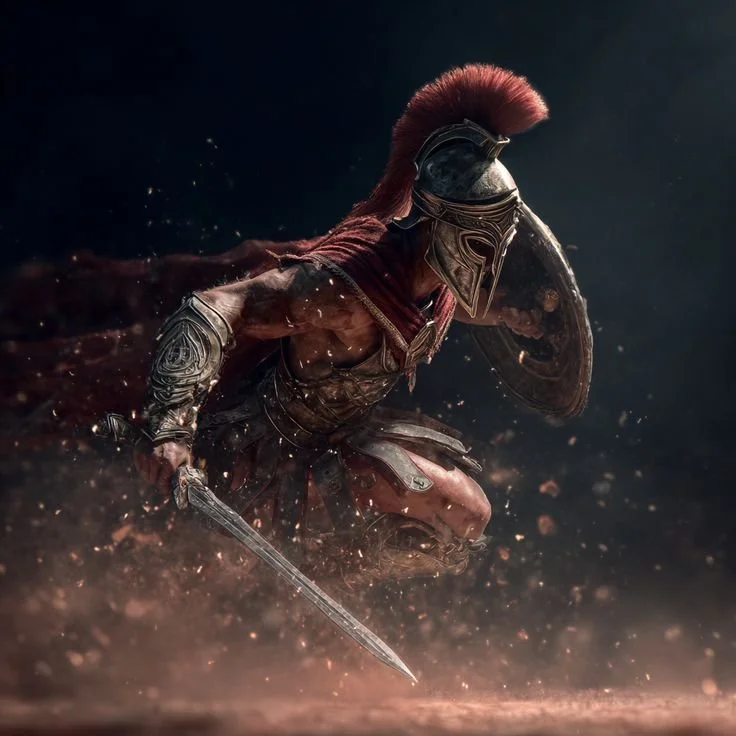
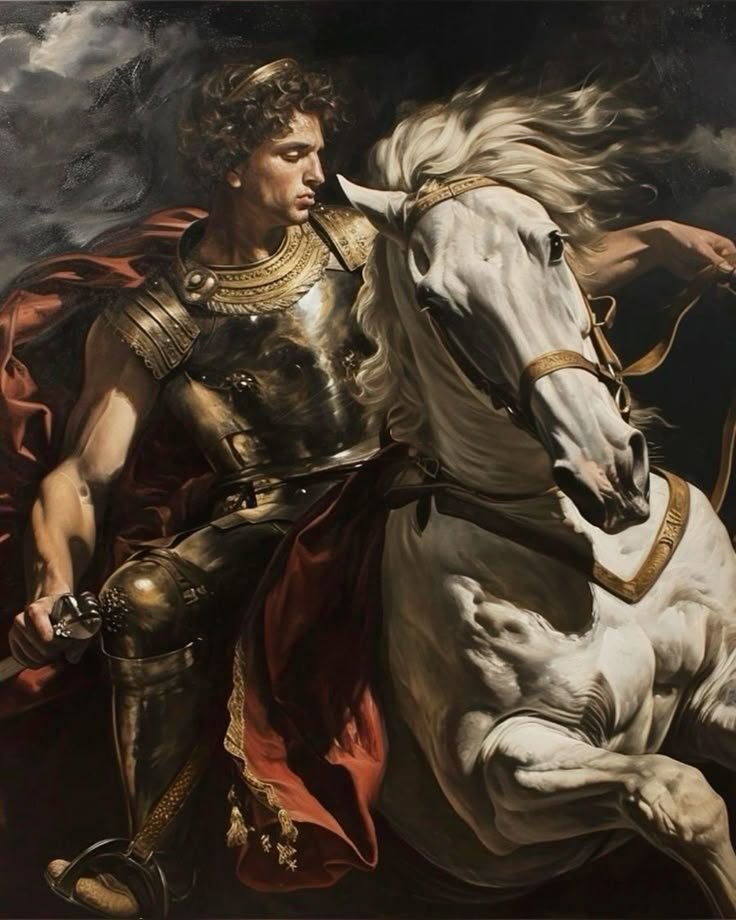
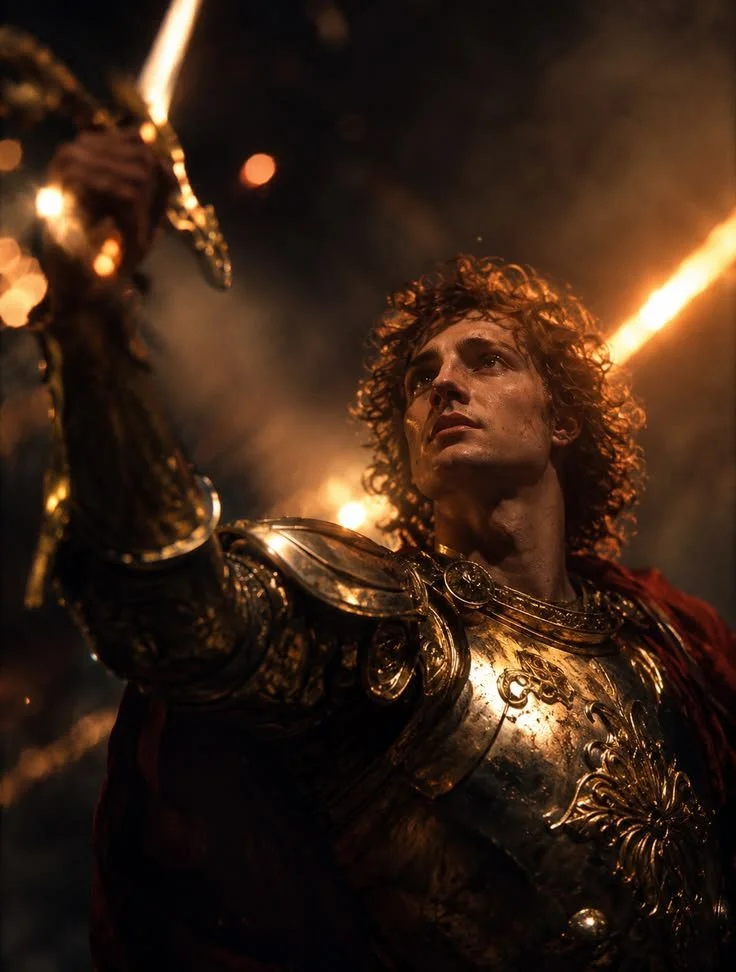

Patroclus was his companion, his closest person, the one who held the softest part of him, and when he died on the battlefield wearing Achilles’ own armor, cut down because Achilles himself had refused to fight, Achilles unraveled in a way that no physical arrow could have caused. He refuses food, rolls in the dust, holds the body and will not let anyone take it, as if keeping the flesh from decay might somehow reverse what happened, and when he finally rises it is not with strategy or honor but with a grief so total it becomes indistinguishable from madness, a weapon that cuts down everything in its path, slaughtering across the Trojan plain and dragging Hector’s body behind his chariot around and around the walls, day after day, desecrating the dead because killing him once was not enough to empty what was burning inside.
He was just a man, raw and broken, tearing through the world because the alternative was sitting still and letting the silence swallow him.
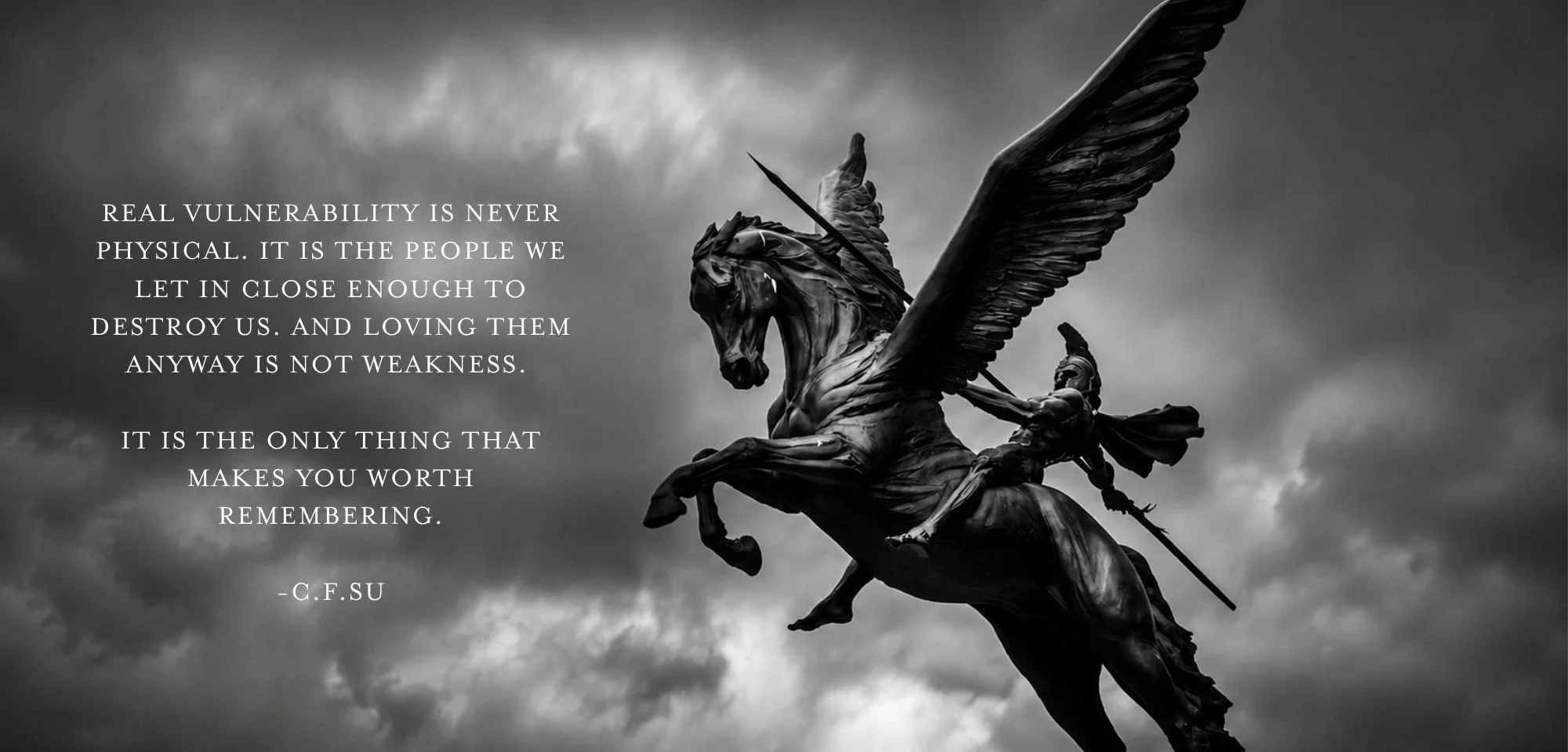
Homer understood that real vulnerability is never physical. It is the people we let in close enough to destroy us. And loving them anyway is not weakness. It is the only thing that makes you worth remembering.
Alexander also had his own Patroclus. His name was Hephaestion, companion, general, the other half of his soul, and when he fell ill and died in Ecbatana, Alexander shattered exactly the same way, laying on the body for a full day and night, refusing food, ordering the mane of every horse in his army cut short and the battlements of every city shaved down, as if his grief should reshape the landscape of the world, building a funeral pyre in Babylon that cost more than most empires could afford, a monument to loss so excessive it could only have been built by a man who had stopped caring about what came after.
And then he kept moving... East. Deeper into the unknown, chasing the edge of the world because stopping would have meant sitting still with what he had lost, and his grief became momentum, a quake that cracked open the known world, the pathways his armies carved becoming the Silk Road, Greek thought meeting Persian spirituality meeting Egyptian astronomy meeting Indian mathematics, the fusion that shaped the next thousand years of human civilization carried on the back of a man who could not stop moving because stopping meant he was still gone.
One wound, one myth, two outcomes. Achilles burned his world down, and Alexander built one, even as he burned through himself.
Grief is not the interruption of the story. Grief is the engine.
Aristotle and the Invisible Transmission
In the quiet hours when the house is asleep and my mind is still fizzing, I keep returning to this: Aristotle taught Alexander first. Aristotle poured philosophy, science, the vision of an ordered cosmos into the young prince, and did he know, did he know that his student would become the engine of a new age, that the ideas he planted would spread across continents, translated into languages he never heard, debated in cities that did not yet exist?
Probably not...
He was just a teacher doing what teachers do, hoping that something would stick.
This is what the deepest transmission looks like, and it is the thing I have been trying to name for years: it does not transfer information. It transfers the capacity to see. Aristotle did not teach Alexander strategy. He taught him that the world was ordered, knowable, beautiful, which is a different thing entirely, because a man who has been taught to memorize maps will stop at the edge of the known world, but a man who has been taught to read the cosmos will keep walking past it.
The mentor who expands how you see does not give you answers. He makes your questions larger. And a person carrying a larger question will shape more history than a person carrying a better plan.
Alexander did not know he was weaving the Silk Road, but something in him, his higher self, the part that slept with the Iliad under his pillow, knew, and the thread was already in his hand, he was just following it, the way you follow a river without needing to know where it ends, trusting that the current always finds the sea.
The Prince in the Vienna Woods
The pattern repeated, in a different century. Menger spent two years tutoring Crown Prince Rudolf of the Habsburg Empire, traveling Europe together, co-writing an anonymous pamphlet attacking the Austrian nobility, pouring into the young prince the liberal ideals he had drawn from Adam Smith: limited government, free exchange, the dignity of the individual against the weight of aristocratic decay. He loved his student the way a teacher loves the one who actually understands what he is trying to say, the one who will carry the vision forward after he is gone, and Rudolf was not merely a student. He was the heir, the progressive hope of an empire rotting from within.
Menger saw the decay clearly, the Habsburg machine grinding toward collapse, and he believed, or hoped, or needed to believe, that Rudolf was the one person who might steer it differently. But in 1889 Rudolf rode into the Vienna Woods at Mayerling with his young mistress and two bodies were found. The official story called it murder suicide, a romantic tragedy, but Ludwig von Mises believed something quieter and harder to carry: that Rudolf had absorbed Menger’s vision so completely, had looked at the future so clearly, that he chose death over watching the collapse he could already see coming.
There are people who see too far ahead and the distance becomes unbearable.
Menger fell into a depression that lasted the rest of his life. He barely published again. Rudolf’s death removed the progressive heir, succession shifted, the old guard tightened its grip, and the path that might have bent toward openness snapped shut. In 1914 Archduke Franz Ferdinand was assassinated in Sarajevo, then the July Crisis, then the Great War, a world Menger had foreseen and could not prevent. You are never just a man. You are a variable in an equation the future is still solving.
This is the third shape: the mentor who could not save his student, the silence that cost more than the war. Menger did not teach Rudolf economics. He taught him a vision of human dignity that made the old world look small by comparison. He successfully expanded him. And when the expansion becomes too large for the container, sometimes the container breaks. Not every transmission survives its vessel but the vision does. It always finds another hand.
My Own Mentor, Dr. Tanner
I have been sitting with these three shapes all week, and they brought me back to my own story, the one I do not always know how to tell. Dr. Tanner, the chief of hospital, was my first mentor. I was young then, watching how he led, how he saw people, how he moved through the world with a quiet authority that never needed to raise its voice, treating patients like human beings instead of charts, leading with unbridled presence. He was like a father to so many of the nurses who worked beside him. He made the unbearable bearable simply because he was there.
Some people make the room feel different just by being in it. He was one of those people.
And then he died.
I remember sobbing in the hallway, the other nurses sobbing with me, because we had lost the one person who made us feel like what we were doing mattered. I sobbed harder for Dr. Tanner than I did when my own father died, and I do not say that to be cruel. I say it because that is the measure of what he was to me. After he was gone they paired me with another doctor and it was not the same, not even close. The friction was immediate and dissonant and unbearable, and that loss cracked something open in me that has never closed again. Some wounds do not heal. They become doors.
I started asking the question that would not leave me alone: what am I here for? Life is too short. That thought kept arriving, uninvited, in the car between shifts, and so I went searching, found someone who could teach me finance, someone who could teach me business, a CEO who taught me systems, taught me how things actually run, and I was not following a plan. I was following the thread, one mentor then another, each one opening a door I did not know existed until I was already walking through it.
Dr. Tanner did not teach me medicine. He taught me presence. He taught me that authority could be gentle. And I understand now what Aristotle and Menger understood, the thing none of them named directly but all of them practiced: the greatest transmission is not the transfer of knowledge. It is the expansion of what the student believes is possible for herself. That is what changes history. Not information. Permission. Permission to be larger.
Matteo
My third and final mentor did not announce himself the way fire announces itself. He walked into a room and the room rearranged around him, because magnetism and authority is not a performance. It is a field you inhabit, and you either have it or you do not, and Matteo had it the way certain people carry a quality that makes you think: “Oh, so this is what a human being looks like when nothing has been wasted in them.”
When he listened, which he did fully, you felt held and understood, aware that most people had only ever been waiting for their turn to speak. His beauty was in the completeness of his attention. He moved through rooms like a planet, slow and inevitable, and people orbited without knowing why. He had the radiance of someone who had been broken and had chosen to keep going, and that choice had left a mark on him that was more beautiful than any bone structure.
He was in his 40s. He had survived more financial battles than most institutions ever face, international construction across time zones, a crypto fund in the years when crypto was still considered madness, a charity that gathered hundreds of children every year and taught them to build portfolios before the world could teach them to be afraid of money. He was holding an empire with both hands and he never once looked like he was about to drop it. When things went seriously wrong, and they did, because things always go seriously wrong at that scale, his response was the same every time: “We find another way.” A philosophical position. A refusal to let circumstance become identity. And he always found a way. He just won’t quit. It was never even an option.
He reminded me of how Alexander reminded himself of Achilles, recognition, the sense that certain souls repeat across centuries wearing different faces, and you know them when you meet them because something in you remembers.
He taught me about Wabi Sabi, the Japanese philosophy of beauty inside constraint and imperfection, the understanding that the crack in the bowl is not a flaw to be hidden but the place where the light comes through. He was not teaching me a concept. He was describing how he lived. Every limitation was a material to work with. Every rupture was a doorway if you were willing to walk through it instead of standing in front of it grieving what used to be whole.
He told me: “I see my younger self in you. I admire your hunger and your vision of the future.”
I wanted so badly to make him proud. That wanting was a desire I haven’t acknowledged yet in myself, so I wanted it through him, as if his approval would make my ambition real, if I was allowed to dream that big, too, or it was possible for me to be just like him. You love your mentors the way you love your highest possibility, because for a time they are the same thing: the proof that the life you are reaching for is not imaginary.
But Matteo had a shadow, the way all great men do, and I saw it clearly even as I admired everything else about him. He was so oriented toward the horizon that he had forgotten to look sideways at what the motion was costing him. His daughter was in another country. He was always moving, always putting out fires in another time zone, always building something larger while something quieter went untended. He was not a negligent man. He was a consumed one, and there is a difference, because the consumed man loves deeply and is still absent, and the people who love him learn to receive a fraction of him and tell themselves it is enough.
I recognized it because I had been learning to receive fractions my whole life.
My father was a surgeon. He was always traveling, always saving someone else, and I loved him for it and it hollowed something out in me at the same time, because a child does not have the philosophical framework to understand that her father’s absence is also a form of love. She only knows the empty chair, the half a life, the loneliness of being someone’s daughter in theory and in passing. I called Matteo the day my father died. He was there. He made me feel less alone in the particular darkness of losing a man you spent your whole life half knowing.
That day I told Matteo something I had never admitted out loud. I was relieved… I did not have to wait for him to come home anymore. There is a strange exhaustion that comes from loving a man who is always almost there, always on his way, always saving someone else in another time zone, and you learn to receive the fraction and call it enough, and you do that for years, for decades, and then one day the waiting ends, and what you feel is not grief the way they write about it in poems. It is a strange, hollow peace. The empty chair is finally honest about what it has always been.
I understand now that I spent years looking for a present male figure not because I was broken but because I was whole enough to know what was missing. The wound of abandonment is not a flaw in the architecture. It is the very blueprint from which everything I build is drawn.
There is a profound connection between brokenness and beauty. Those who have been shattered know the agonizing weight of reaching for light when every instinct insists that none exists. Beauty becomes a remnant of something lost, a fleeting echo of a wholeness we can taste only in heartbreaking glimpses, and for the fractured, it is not a luxury but the raw necessity that jerks the senses awake from the dull numbness of mere survival. To arrive at beauty from the place of fracture means enduring the terrible honesty of seeing your own ugliness and refusing to hide the parts that most need mending, because transformation only touches what we have the courage to show. It means carrying the ordinary, crushing difficulty of living and yet, with trembling hands, forcing something transcendent from your own ruins as a defiant weapon against death and decay. Beauty does not erase the pain. It sharpens it, then stretches your imagination just enough to believe that a story of healing might one day be more beautiful than anything that never broke at all.
Because here is what I have come to understand about the men in my life, the ones who broke my heart and the ones who expanded it, the fathers by blood and the fathers by choice: they were not absent because they did not love. They were absent because nobody had ever told them that the empire they were building would be worth nothing if there was no one at the table when they finally came home.
They were Achilles going to a war he did not choose, compliant, molded, told that Greece would fall without them, pushing the boulder up the mountain because that is what a man of conscience does when the thing he loves is threatened, and they were magnificent, and they were lonely, and most of them never once stopped to ask whether the boulder was the point or the pushing was the punishment.
That is the wound underneath the wound. And it breaks my heart wide open every time I think about it.
The system did not make soldiers out of bad men. It made soldiers out of the best ones, the most driven, the most capable, the ones with the most to give, and it took that giving and pointed it away from the people who needed it most and called the resulting emptiness success. Currency debases. Empires rise and fall. Artifacts survive for centuries and then turn to dust. But a child who grew up knowing her father is present carries that in her bones in a way that no market correction can touch, and the man who was there for that is living inside every decision she will ever make, in every room she will ever walk into, in every version of herself she will ever dare to become.
True legacy is not what you built. It is who was in the room when you built it.
This makes me think about the women of ancient Greece, the mothers and wives and daughters who watched Alexander ride east, who stood at the edge of the city walls and waved until the dust swallowed the last horse, who went back to the loom and the kitchen and the children and the long nights of not knowing. Their husbands and sons were off conquering the known world, and what did they get? An empty bed. A name in a letter that took months to arrive. A body that never came home, or came home broken, or came home so changed that the man who left was already a ghost.
I have been thinking about what they felt. Not the grand emotions of epic poetry but the quiet ones, the ones that do not make it into the history books. The slow erosion of waiting. The way hope becomes a habit before it becomes a curse. The moment a woman realizes that the empire her man is building will never build a room for her.
We have all been servants of a beast machine that taught us to forget that love is the whole meaning of life. We are here to love and be loved. Everything else, the conquest, the wealth, the empire, the algorithm, the smooth, it is all just the exhaust. It is the noise we make while we are avoiding the only question that actually matters: who is sitting across from you, and have you really seen them today?
So I am not angry at the men who broke my heart. I am something quieter. I am a woman on the other side of the fire, looking back at all of it, the glory and the grief, the absence and the love that was real even when it was not enough, and I am feeling the weight of it, the beauty of it, because beauty is not just the pretty light things.
Beauty is the crack in the bowl where the light comes through, the thing that forces you to transform through wisdom even when the transformation hurts. By feeling with the heart rather than only thinking with the mind, we begin to see the eternal beauties, the ones that survive every empire, every debasement, every long night of not knowing.
I am not here to blame them. I am here to wake us all up.
The Weaver’s Choice
Somewhere between the loom and the battlefield there is a choice that nobody names because it is too quiet to see. It is the choice between weaving and being woven. Every man who left for glory, every woman who stayed at the wall, every child who learned to call absence love, they were all making a pattern, but most of them never asked whether the pattern was theirs. The loom does not care who sits at it. The cloth grows either way. The only difference is whether you are holding the shuttle or whether the shuttle is holding you, pulling you through the warp and weft of a design you agreed to before you knew what agreement meant.
Look at your life right now. Look at the thing you are building that keeps you from the table. Look at the chair you keep leaving empty. That is the Weaver’s Choice. It is not made once. It is made every morning, every time you say yes to the empire and no to the room where the people who love you are waiting. And the terrible secret is that most of us choose the loom because we are afraid that if we stop, the whole cloth will unravel, and we will discover we were never the weaver at all.
The Forge
I need to say something I have earned the right to say. I have been in the dark long enough to know that the dark is not absence. I have been pressed long enough to feel my own edges dissolving. I have broken the parts of me that were never me, and I will break more, because the stone is not finished and the chisel does not stop. I am still in the fire, but the fire is my element now. I am not asking you to trust a completed teacher, only someone with a finished enough story, someone who knows the forge well enough to stand in it while it is still hot, who can hold the flame without claiming to be the fire itself.
The Tastemakers who write to me, who tell me they have reclaimed their sovereignty, who found their spine because something in my voice reminded them of their own, they are not proof that I have arrived. They are proof that the transmission works even when the transmitter is still being forged. That is the only miracle I know. That is the only one I need.
The Warrior Wakes Up
For the last several weeks, circling these figures, Achilles, Alexander, Menger, Dr. Tanner, Matteo, the ones who shaped and were shaped by history, I have felt something old and bright awaken inside me. Not inspiration. Activation. The warrior inside me waking up, not the warrior who conquers but the one who refuses to let the wound have the final word.
My heart has been broken by men more times than I know how to count, and I say that not as complaint but as credential. The system made me single, made me celibate, gave me back my own time and my own power and my own ferocious unspent love, and I took all of it and turned it here, toward this, toward you. Every heartbreak was a refinement. Every empty chair was a lesson in what the chair was supposed to hold. Every man who was magnificent and absent taught me precisely what I am here to say.
This ascension is not about saving women. It is about waking men up.
I want men to remember who they are and what they are actually fighting for. I want the soldier of capitalism to put down the boulder long enough to look at his hands and ask whose life he is building and whether they will know his face when it is over. I want the driven man, the consumed man, the man who is always moving because stopping means remembering, to stop, just for a moment, and let himself be seen by the people who already love him.
A writer does not pour water from a helmet or break ice with a pick. What she does is harder to witness and harder to undo: she goes into an idea fully, stays there past the point of comfort, and brings back something true. The battlefield looks different now. It is the algorithm, the room where everyone is performing and no one is believing, the moment when you have to decide whether to speak the true thing or the smooth thing. The warrior inside me does not want to win that battle. She wants to make it unavoidable.
Alexander ran barefoot at Achilles’ tomb because he was reporting for duty to a living archetype. I am doing the same thing every time I hit record, every time I write a transmission, every time I refuse to let the grief curdle into silence or destruction and instead forge it into momentum, not pretending to be the myth but inhabiting it so completely that the myth and the woman become impossible to separate.
They reached across millennia and woke something in me that had been waiting. That is what the great archetypes do. They do not ask you to worship them. They ask you to become the next hero of the same story, and the becoming requires something that cannot be performed or purchased or scrolled into existence. It requires the willingness to move from your own center rather than be moved by someone else’s current, to ask not what the world needs from you but what you actually came here for, and then to go there with everything you have, trusting that the right path is not found but made, laid down one step at a time beneath feet that refused to stop walking.
Why I Named You the Tastemakers

I named you this because I believe something that has been living in my chest for years, and the lecture I watched this week finally gave it language. I believe the Titans and the Muses belong together, not as opposites to be balanced but as a marriage, a single organism with two minds: the strategist and the artist, the architect and the oracle, the hand that builds and the ear that listens.
Their union is what produces beauty, not the beauty of decoration or the smoothness that asks nothing of you but a thumb tap and a second of forgetfulness, but beauty as revelation, the ancient kind, the kind that makes you stop scrolling and sit in silence because something true has just looked back at you from the page, from the canvas, from the voice in your headphones at two in the morning when the highway is empty and you are finally alone enough to hear it.
The union of love and beauty was never a gentle affair. It was a candescent force that burned as often as it warmed. The goddess of desire was born from the same primordial night as the wildness of war, making her the natural lover of the god of conflict. Their bond produced children who carried this duality, not just harmony but also dread and fear, the vertigo of loving as a real and literal affliction, a force capable of loosening knees and leaving the heart maddened. This version of beauty was not a passive aesthetic but a catalyst, an incandescence that led directly to the battlefields of Troy and the ruins of Carthage. The goddess of love remains both the wound and the bandage, a reminder that human passion is inextricably linked to the volatile energy that drives us to war.
That is what we have lost when we traded beauty for the smooth and easy. The smooth does not wound you. It also does not heal you. It keeps you in a room with no edges, no fire, no possibility of transformation, because transformation requires the heat that the smooth carefully filters out.
The Titan without the Muse becomes a soulless soldier. The Muse without the Titan becomes a ghost. Together they become something the world has not had enough of: a builder who knows what he is building for.
Beauty is not decoration. It is disclosure. It is the moment the world stops performing and shows you what it actually is.
We have replaced this ancient notion of beauty, beauty as sacred, as an occurrence of truth, as one of the primary ways the divine manifests in the world, with something called the aesthetics of the smooth. Smooth things are easy. They are consumable without friction. They flatten reality until it is shallow enough to scroll past: a screen, a feed, a face optimized for engagement. The smooth does not reveal, instead it masks. It makes everything forgettable, which is exactly what the algorithm wants, because a person who remembers what she truly wants is a person who can no longer be sold what she does not need.
There are two fundamental ways of being in the world. The having mode, which is about possessing and consuming, and the being mode, which is about becoming and participating in mystery. When you try to satisfy your being needs from the having mode you end up empty, because you are trying to fill a depth with a surface. The aesthetics of the smooth lures you into this confusion, telling you that if you just keep scrolling, just keep buying, just keep producing, you will finally feel whole, and it leaves you more fragmented than before because the smooth has no depth and cannot hold you. You cannot fill a soul with a surface. You can only stretch it thinner.
The Responsibility
This is not a hobby. This is not a brand or content. Being a Tastemaker is a responsibility. You are a keeper of the primordial flame. The intelligence and the passion that you carry are not yours to hoard. They are yours to transmit. Aristotle did not keep his vision of the ordered cosmos in a notebook. He poured it into a boy who would become the engine of a new age. Homer did not write for himself. He wrote so the boats would keep rowing for three thousand years. Menger did not build his theories for tenure. He planted them in a prince, hoping they would outlast the empire.

The flame does not stay alive by being held. It stays alive by being passed.
But not every flame finds the next hand. Menger poured his philosophy into a prince who was meant to turn an empire, and when the prince rode into the Vienna Woods and did not come back, Menger stopped pouring. He fell into a silence that lasted the rest of his life. The chain broke at his wrist and he never picked up the thread again. This is the ghost that sits in every room where transmission is attempted: the possibility that you will give your fire to someone who breaks, or that you will break before the fire reaches the next in line. The ghost does not mean the work is futile. It means the work is fragile. And fragility is what makes it real.
You are not here to consume wisdom. You are here to carry it, to refine it, and to hand it to the next person in line while it is still burning. That is the whole meaning of the chain. The transmission does not break because the links are strong. It breaks because someone decided to hold the fire instead of passing it.
Intelligence without passion is a dead engine. Passion without intelligence is a wildfire that burns the house down. You need both: the mind that sees the pattern and the heart that feels the weight of it, the strategist who knows the terrain and the artist who knows what the fight is actually for. That marriage is what makes the flame steady enough to travel.
The transmission only works if the vessel is awake. A hero is not born from certainty. A hero is born from the willingness to ask a different question than the one the world handed them. And the difference between a hero and someone merely performing heroism is consciousness, the quality of attention you bring to your own becoming, whether you are moving from your own center or being carried by someone else’s current.
If you are reading this and you feel the stirring, the recognition, the sense that you have been waiting for permission to become what you already are, then hear this. You have permission. But permission comes with duty. You are now responsible for the next link in the chain. You are responsible for finding the hand that comes after yours and placing the flame in it before your own goes out.
That is what it means to be a Tastemaker. Not taste as preference. Taste as discernment. Taste as the ability to recognize what is real and refuse to let it be flattened into what is merely convenient. Taste as the courage to say: this is worth keeping, this is worth passing, this is worth the heat.
The Chain Does Not Break
Think of my grandfather’s hands on the back of my bicycle seat, that last morning, the moment just before the letting go, the fraction of a second where I was still being held and then I was not, and the wheels kept turning, and I did not fall, and when I looked back he was standing in the middle of the road with his hands at his sides and something on his face that was not quite pride and not quite grief but the particular expression of someone who has just finished his most important work.
I did not need training wheels anymore. The student became the teacher.
Orientation and posturing cannot be bought or read into existence. They can only be transmitted through proximity, through watching someone carry themselves through catastrophe with composure, through having someone look at you and say: “I see my younger self in you.” You cannot get that from a book. You can only get it from standing close enough to another human being that their way of moving through the world begins to reorganize your own.
That is what my mentors gave me. Not knowledge. Not strategy. A new way of standing in a room. How to hold myself when everything falls apart. To be brave over and over again with my full chest.
And now I am on the other side. I am the voice in someone’s headphones. Somewhere a nurse is driving home from a shift she is exhausted by, listening to me the way I once listened to voices in the dark between hospital shifts, feeling something in her heart that she does not yet have language for. I am standing where Aristotle stood, where Menger and Dr. Tanner and Matteo stood, where my grandfather stood on the last morning with his hands on the back of a bicycle that was about to ride itself. I am the mentor now, and I do not know which of my listeners is the one, the one who will take what I am transmitting and turn it into something I cannot yet see, because the Silk Road was not designed. It was the exhaust of a heart that could not stop beating, a grief that became momentum, a student who carried her teacher’s vision further than the teacher ever could.
I’m looking for the diamond souls. The rare people in whom the transmission will catch fire.
The thread is already in your hand. You do not need to see the whole path. You only need to take the next step, and the step after that, and before you know it you look back and the path is there, already behind you, already holding your footprints. You did not find the path. You created it. And someone in the future will trace their becoming back to this week, this breath, this decision, and they will say: thank god for them, we would not be here.
The chain does not break. It only finds new hands.
The Invitation
This newsletter is open to anyone. But what I am building here runs on the people who choose to carry the flame. If that is you, become a paid subscriber. You will get the activation, the frequency, direct transmission, the work. You will be building this thing with me and passing the flame to the next Tastemaker, the next legacy builder, the next keeper of the fire.
I have been inside the rooms where the degrees do not matter, and I have seen what the men in those rooms lost to gain what they have.
The flame is in your hands now. But what are you building that requires your absence, and who is sitting in the chair you keep leaving empty?
Thank you for receiving this transmission. To my patrons and paid community… thank you. You’re not just supporting me, you’re helping us co-create the conscious web & more beautiful future we all keep dreaming about.
Celinne